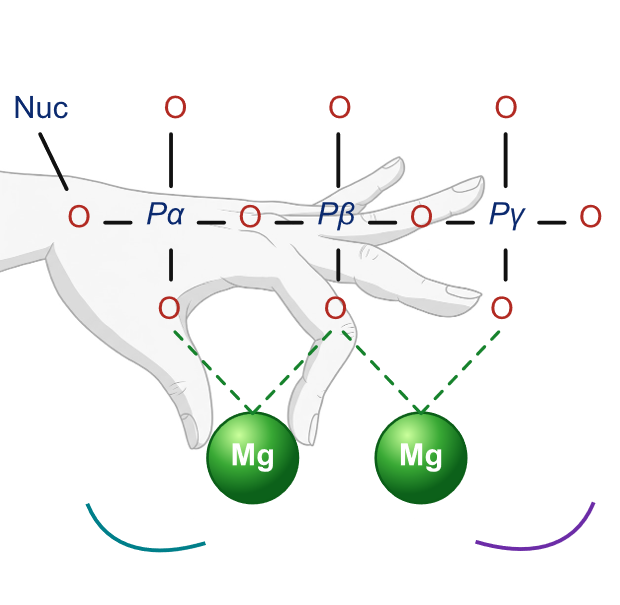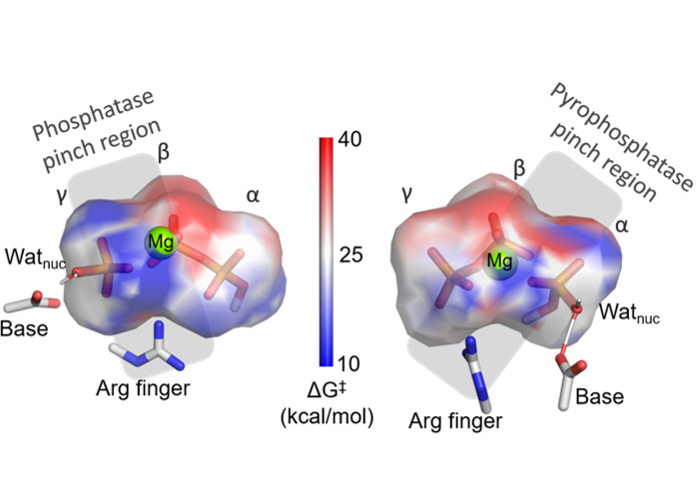







Nature counts to three: the universal Mg-pinch motif
Structural analysis and DFT QM/MM calculations identify how Mg2+ preorganises and polarises the phosphate groups flanking the cleaved P–O bond.
Open paper
Molecular modelling · University College London
We develop multiscale molecular modelling methods to resolve reaction mechanisms, free-energy landscapes and biomolecular kinetics, connecting electronic structure to experimentally observable function.
Our perspective
Molecular function emerges from coupled electronic, conformational and kinetic processes across disparate length and time scales.
We combine electronic-structure theory, QM/MM, molecular dynamics and statistical mechanics to quantify mechanisms and ensembles that are not directly accessible experimentally.
Method development is coupled to high-performance computation and close experimental collaboration, enabling mechanistic interpretation and prospective molecular design.
Research
We resolve enzyme-catalysed reaction pathways with QM/MM free-energy calculations, including proton transfer, phosphoryl chemistry and metal-dependent reactivity.
02We estimate thermodynamic states and transition kinetics using enhanced sampling, dynamic histogram analysis and Markov or graph-based representations.
03Alchemical free-energy calculations and conformational ensembles quantify ligand binding, mutational effects and cooperativity in multicomponent complexes.
Selected work

Structural analysis and DFT QM/MM calculations identify how Mg2+ preorganises and polarises the phosphate groups flanking the cleaved P–O bond.
Open paperA prospective, community-scale assessment of structure-based and ligand-based hit-finding protocols against an antiviral macrodomain.
Open paperQM/MM free-energy calculations resolve the dependence of phosphohydrolase catalysis on metal identity and coordination geometry.
Open paper